
Why Smart Scales Show Inaccurate Body Fat Percentages
Learn why smart scales show inaccurate body fat percentages, how bioelectrical impedance works, and how to track your progress reliably.
· 5 min read
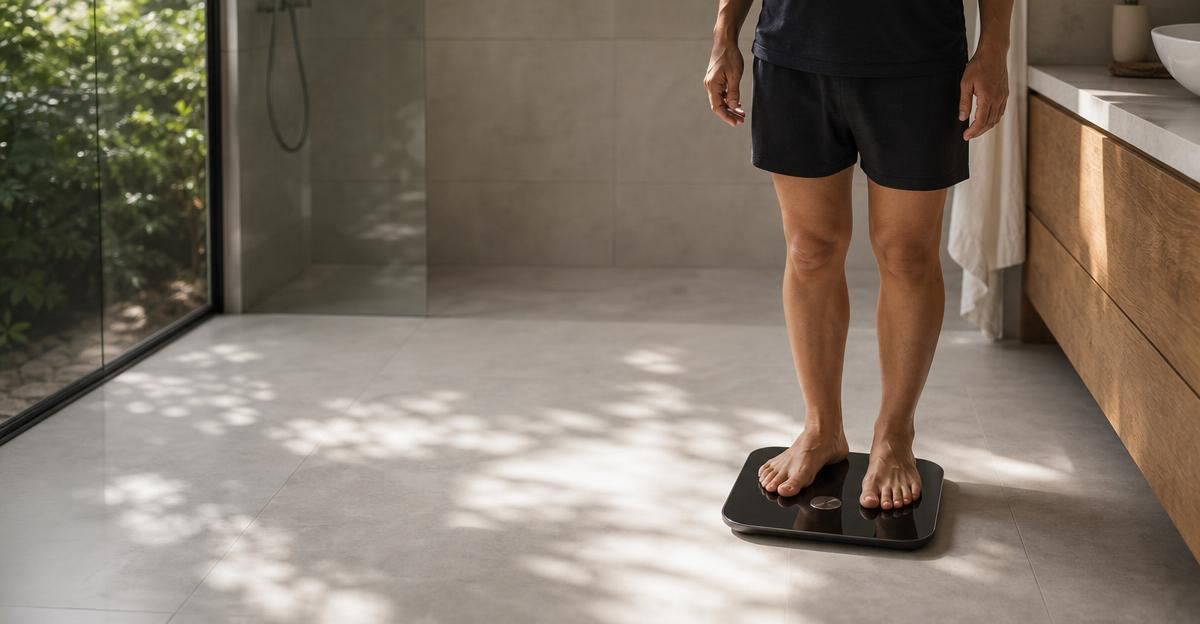
You step on your bathroom scale on Tuesday morning, and it displays a body fat percentage of 22%. On Wednesday morning, after a long run and a light dinner, you step on it again—only to see 24.5%. Gaining two and a half percentage points of pure body fat overnight is physiologically impossible, yet smart scales report numbers like this all the time.
Smart scales are convenient tools for tracking overall body mass over time, but their body fat readings often cause unnecessary frustration and confusion. Understanding how these devices calculate body composition—and why those calculations are easily distorted—can help you interpret your numbers with clarity rather than stress.
How Bioelectrical Impedance Works
Consumer smart scales estimate body composition using a method called bioelectrical impedance analysis (BIA). When you stand barefoot on the metal contact pads, the scale sends a tiny, painless alternating electrical current up through one leg, across your pelvis, and down through the other leg.
The scale measures impedance, which is the resistance and reactance the current meets as it travels through your tissues:
- Lean tissue and water: Water and muscle contain high concentrations of water and electrolytes, making them excellent conductors of electricity. Current moves through them quickly with low resistance.
- Adipose tissue (fat): Fat contains very little water, so it acts as an insulator, resisting the flow of the electrical current.
Once the scale measures the total resistance, it plugs that number into a proprietary mathematical equation. This formula combines the measured impedance with the personal data you entered during setup—such as your age, height, biological sex, and general activity level—to calculate an estimated percentage of fat mass and lean mass.
The Flaws of Single-Frequency Foot-to-Foot Scales
While clinical BIA machines use multiple electrical frequencies and contact points across both the hands and feet, most home smart scales rely on a single frequency passing only through your lower limbs.
This foot-to-foot design introduces a fundamental blind spot: the electrical current takes the path of least resistance. It travels up one leg, cuts across your lower pelvis, and goes straight down the other leg. The scale never truly analyzes your abdomen, chest, back, or arms. Instead, the device assumes your upper body has the exact same lean-to-fat ratio as your lower body, which is rarely accurate for most people.
Why Your Hydration Status Changes the Reading
The biggest source of day-to-day error on a smart scale is hydration. Because the device relies entirely on water content to distinguish between lean tissue and fat, any shift in your body's fluid balance will drastically skew the result.
A review indexed by PubMed Central research on bioelectrical impedance techniques notes that small variations in fluid distribution, electrode contact, and hydration status significantly alter raw impedance values.
Here is how common daily shifts confuse the scale:
- Dehydration: When you are dehydrated—whether from sweating during exercise, drinking alcohol the night before, or simply waking up thirsty—your body holds less conductive water. The scale measures higher electrical resistance and incorrectly flags that missing water as extra body fat.
- Heavy carbohydrate meals: Glycogen storage pulls water into muscle cells. If you eat a high-carbohydrate meal, your muscles temporarily store more water, which lowers electrical resistance and causes the scale to report an artificially low body fat reading.
- Salty foods: High sodium intake causes temporary fluid retention. Depending on where that fluid gathers, it can either suppress or inflate the estimated fat percentage.
Just as why daily weight fluctuates and how to read the trend comes down to fluid shifts rather than sudden fat gain, the body fat reading swings for the exact same reasons.
Skin Temperature and Exercise Effects
Hydration is not the only variable that alters electrical conductivity. Skin temperature and circulation also play a notable role.
When your skin is cold, blood vessels near the surface constrict, increasing electrical resistance at the contact points on your feet. The scale registers this as higher impedance and calculates a higher body fat percentage. Conversely, taking a warm shower or standing on the scale immediately after a workout increases blood flow to your extremities and skin surface, lowering resistance and artificially lowering your reported body fat.
Thick calluses on the soles of your feet can also impede the electrical current before it even enters your body, adding baseline resistance that distorts the calculation.
How to Get More Meaningful Data from Your Scale
You do not need to throw away your smart scale, but you should treat its body fat estimate as a rough, relative metric rather than an exact measurement. If you want to use it effectively, follow a few practical guidelines:
- Standardize your testing conditions: Step on the scale at the exact same time under identical conditions. The most reliable window is first thing in the morning, immediately after using the bathroom and before drinking water or eating breakfast.
- Track the rolling average: Never react to a single day's spike or drop. Look at the trendline across four to six weeks to see if the overall direction aligns with your fitness habits.
- Use multiple checkpoints: Do not rely on one metric to assess physical progress. Track how your clothes fit, monitor your strength numbers in the gym, take circumference measurements around your waist, and capture progress photos under consistent lighting.
Using connected home wellness tools can simplify daily routines, much like modern setups for Safe And Simple Smart Personal Home Care help keep daily health routines structured and accessible. Just remember that consumer sensors are best viewed as broad compasses rather than clinical laboratory tools. If you ever have specific concerns regarding your body composition or metabolic health, speak to a qualified clinician or registered dietitian.
Focus on the Habits You Control
A smart scale cannot tell the difference between a glass of water, an intense workout, and genuine tissue changes from day to day. While the technology is helpful for monitoring long-term weight trends, daily fluctuations in body fat percentages are almost always noise caused by fluid shifts.
Instead of stressing over daily percentage swings, focus on the consistent daily actions that drive long-term health: balanced nutrition, adequate protein, regular strength training, and quality sleep.
Logging your daily habits gives you the context your scale lacks. With Stride, you can easily log your meals, track your workouts, and monitor weight trends in one place to see the complete picture of your health progress.
Put this into practice with Stride
Log meals, training, weight and sleep in seconds, then get guidance that fits your own numbers.
Try Stride free