
Oatmeal Calories and Fiber: Dry vs. Cooked Portions
Learn how to accurately track calories and fiber in dry versus cooked oatmeal portions, avoid common logging mistakes, and keep your nutrition on target.
· 5 min read
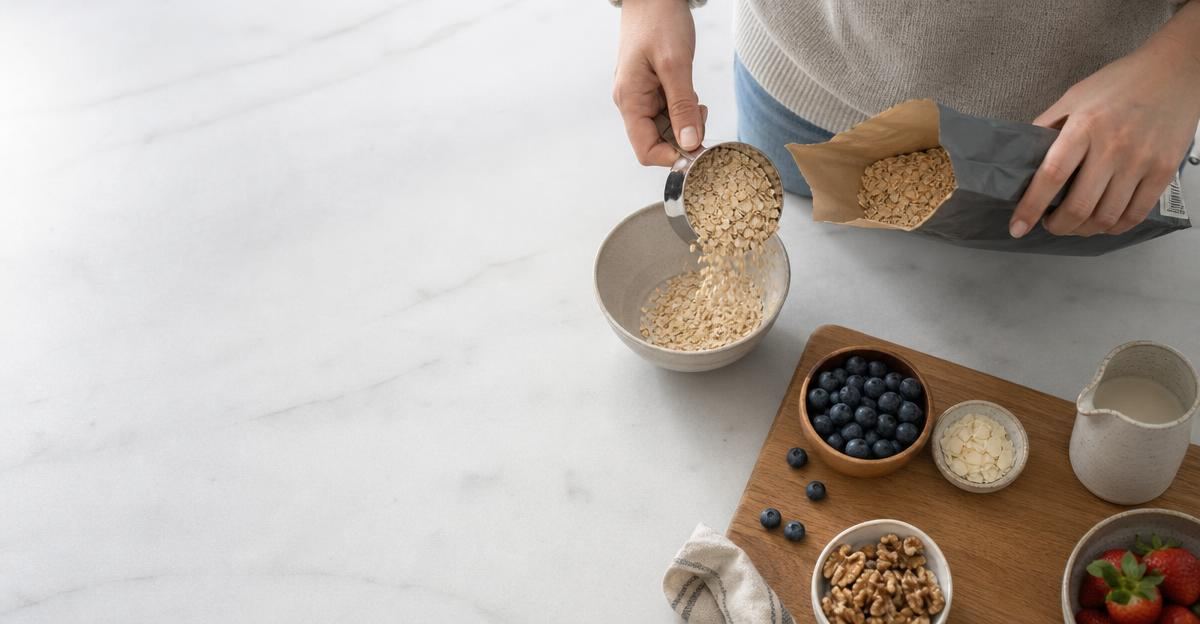
A warm bowl of oatmeal is one of the most reliable breakfast staples around. It is filling, versatile, and packed with complex carbohydrates and soluble fiber. Yet when it comes to logging breakfast into your nutrition tracker, oatmeal is a frequent source of confusion.
A common scenario plays out like this: you scoop a cup of cooked oatmeal into your bowl, search your tracker, and log "1 cup of oatmeal." Depending on whether the entry in the database refers to dry oats or cooked oats, your logged intake could be off by more than double.
Understanding how water alters food volume and weight is essential for accurate nutrition tracking. Here is how to navigate the difference between dry and cooked portions of oatmeal so you can track your calories and fiber with confidence.
Why the Discrepancy Happens
Oats expand significantly during cooking. As rolled or steel-cut oats simmer in water or milk, the starch granules absorb liquid and swell.
A standard dry serving of rolled oats is typically one-half cup (about 40 grams). When you cook that half-cup of dry oats with one cup of water, it yields roughly one full cup of prepared oatmeal.
Water contains zero calories, zero carbohydrates, and zero fiber. Therefore, the nutritional profile of that half-cup dry serving and the resulting one-cup cooked serving is nearly identical—assuming you cooked it in plain water.
However, if you scoop out one cup of dry oats, you are holding roughly 80 grams of raw grain. If you log that cup as "cooked oatmeal," you will dramatically underestimate what you ate. Conversely, if you scoop one cup of cooked oatmeal from a prepared batch and log it as "1 cup dry oats," you will overestimate your calories by nearly 100%.
According to standard USDA food composition data, a 40-gram serving of dry rolled oats provides roughly 150 calories, 5 grams of protein, 27 grams of carbohydrates, and 4 grams of dietary fiber. Once cooked in water, that same 150-calorie profile simply occupies more physical space in your bowl.
Dry vs. Cooked by Weight and Volume
Measuring by volume (cups and tablespoons) is convenient, but it introduces variability based on how tightly the oats settle. Measuring by weight with a simple kitchen scale provides the clearest picture.
Here is a general breakdown of how rolled oats compare across states:
- Dry Rolled Oats (1/2 cup / 40g): ~150 calories, 4g fiber, 27g carbs, 5g protein
- Cooked Rolled Oats in Water (1 cup / ~234g): ~150 to 160 calories, 4g fiber, 27g carbs, 5g protein
- Cooked Rolled Oats by Dry Measure (1 cup dry / 80g): ~300 calories, 8g fiber, 54g carbs, 10g protein
Steel-cut oats are denser than rolled oats and absorb even more liquid over a longer cooking time. A quarter-cup of dry steel-cut oats (about 40 grams) also yields about three-quarters to one cup of cooked cereal.
If you prepare large batches ahead of time, learning how to track multi-ingredient home-cooked meals fast can help you divide portions accurately throughout the week.
Which Method Should You Use to Log?
Whenever possible, weighing or measuring your oats dry before cooking is the most precise method.
When you weigh dry oats, you eliminate the variable of cooking liquid. One person might prefer thick oatmeal made with a 1:1.5 ratio of oats to water, while another prefers a looser texture made with a 1:3 ratio. Both bowls could weigh completely different amounts after cooking, yet both contain the exact same baseline calories and fiber because the dry grain portion was identical.
How to Log Single Servings
If you make oatmeal one serving at a time:
- Place your bowl on a kitchen scale and tare it to zero.
- Pour in your dry oats (for example, 40 grams).
- Log "rolled oats, dry" for 40 grams.
- Add your water or milk and cook as usual. (Remember to log any milk, sweetener, or fruit added).
How to Log Batch-Cooked Oatmeal
If you cook four servings of oatmeal in a pot on Sunday for the week ahead:
- Weigh or calculate the total raw ingredients that go into the pot.
- Once cooked, weigh the entire finished batch in grams.
- When dishing out a morning portion, calculate the percentage of the total weight you scooped, or log the cooked weight against a verified cooked entry.
For older adults or individuals receiving meal assistance through a service like homecare.life, prepared foods are often portioned after cooking. In these situations, selecting a verified "cooked in water" database entry matched to a measured cup or gram weight is a practical approach.
Navigating the Fiber in Your Bowl
Oatmeal is widely prized for its beta-glucan content, a type of soluble fiber that supports healthy cholesterol levels and digestive wellness.
Because cooking does not destroy or diminish the dietary fiber in oats, you receive the full fiber benefit whether you eat your oats raw (such as in overnight oats) or cooked into warm porridge. A standard dry serving of 40 grams delivers about 4 grams of total fiber.
To boost the fiber content of your morning bowl without dramatically increasing preparation time, you can stir in additions such as:
- Ground flaxseed: 1 tablespoon adds roughly 2 grams of fiber.
- Chia seeds: 1 tablespoon adds about 4 to 5 grams of fiber.
- Fresh berries: A half-cup of raspberries or blackberries contributes roughly 4 grams of fiber.
Common Tracking Pitfalls to Avoid
Beyond the raw versus cooked confusion, a few subtle additions can change your meal's energy density:
- Liquid Choices: Cooking oats in whole milk, oat milk, or almond milk adds calories, protein, and fats that are not present when cooking in water. Always log your cooking liquid separately if it is not plain water.
- Hidden Mix-Ins: Nut butters, honey, maple syrup, dried fruit, and brown sugar add up quickly. A tablespoon of peanut butter adds around 90 to 100 calories; a tablespoon of honey adds roughly 60 calories.
- Instant Oatmeal Packets: Flavored instant oatmeal packets often contain added sugars and slightly different serving weights than plain rolled oats. Check the nutrition label on the specific box rather than using a generic rolled oats entry.
Keeping Nutrition Tracking Simple
Nutrition tracking does not require perfection, but establishing consistent habits around staple foods removes guesswork from your daily log. Decide whether you prefer measuring dry grain or cooked portions, stick to that method, and use consistent database entries.
If you want a straightforward way to capture your meals, daily activity, and wellness trends without friction, consider using Stride. With Stride, you can snap a photo of your breakfast, record your workouts, track your weight, and view your daily progress in one clear, unified space.
Put this into practice with Stride
Log meals, training, weight and sleep in seconds, then get guidance that fits your own numbers.
Try Stride free