
How to Use Habit Triggers to Take Medications on Time
Learn how to use habit triggers and environmental cues to take your medications on time every day without relying on memory or alarms.
· 4 min read
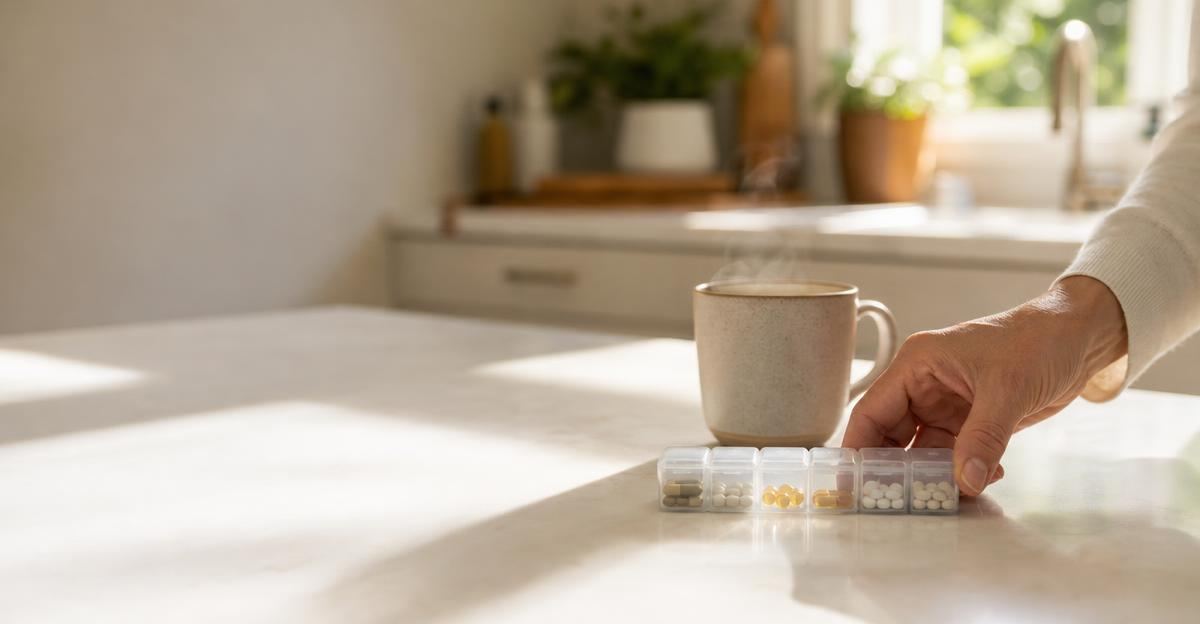
Remembering to take daily medications or supplements sounds straightforward until real life intervenes. A shift in your morning schedule, a busy workday, or an unexpected phone call can easily derail your intentions. When we rely solely on memory or standard phone alarms that are easy to snooze and forget, consistency drops.
Building automated consistency comes down to environmental design and habit triggers. By attaching your medication schedule to stable parts of your day, you remove the mental effort of remembering.
Here is general information on how to design practical habit loops around your medication routine. Always speak to your doctor or pharmacist about the exact timing, dietary requirements, and specific safety rules for your prescriptions.
Understanding the Habit Loop
Every sustainable routine relies on a simple behavioral chain: a cue (the trigger), a behavior (taking the dose), and a reward (a sense of completion or moving to the next part of your morning).
When people struggle with adherence, the problem is rarely motivation. It is usually an unstable cue. A generic digital reminder set for 8:00 AM fails if you happen to be on a call, driving, or in the shower when the chime goes off. Once silenced, the cue disappears, and the medication remains untaken.
A physical habit trigger ties your dose to an automatic, non-negotiable event that already happens every single day regardless of your calendar.
Pairing Doses with Anchored Daily Events
To create reliable triggers, identify what behavioral scientists call "anchor habits"—actions you perform without thinking. Good anchors have fixed locations and predictable timing.
Consider these common daily anchors:
- Morning beverage preparation: Placing your weekly pill container next to the coffee grinder or electric kettle links your morning dose to the five minutes you spend waiting for coffee to brew.
- Brushing your teeth: Storing evening medications right beside your toothbrush creates an unavoidable visual cue before you go to sleep.
- Plating lunch: If your prescription requires food, positioning the bottle directly next to your dining plates makes taking your tablet an automatic step in setting the table.
When you learn how to track medications and daily habits together, pairing your routine with established milestones makes adherence feel effortless rather than like an extra chore.
Designing Visual and Environmental Cues
Out of sight usually means out of mind. Storing daily maintenance pills hidden inside deep medicine cabinets increases the chances you will forget them. Environmental cues create friction-free prompts that nudge you at the exact moment of action.
- Keep bottles in your line of sight: Place your daily organizer on the kitchen counter, next to your computer monitor, or by your bedside table—provided medications are stored safely out of reach of children and pets.
- Turn bottles upside down after taking them: If you take medication directly from a bottle, flipping it upside down immediately after your dose provides an instant visual confirmation that you already took it today, preventing double-dosing.
- Use location-specific backups: If you frequently take an afternoon dose while working or commuting, keep a small travel organizer inside your daily bag rather than expecting yourself to remember to bring loose pills each morning.
Public health organizations emphasize that simple daily habits and visual aids play a major role in managing chronic conditions. According to the CDC guidance on medication adherence, establishing straightforward daily cues helps individuals avoid missed doses and maintain stable health management over the long term.
Handling Complex and Multi-Dose Schedules
When you manage multiple prescriptions with varying requirements—such as thyroid medications that require an empty stomach, or evening doses that cause drowsiness—a single habit trigger may not cover everything.
In these situations, build distinct micro-routines for each window:
- Wake-up trigger: Place your fasting morning pill alongside a full glass of water on your nightstand. Take it the moment your feet touch the floor before you walk to the bathroom.
- Midday trigger: Pair lunch doses with your midday meal logging routine so that opening your food tracking app naturally prompts your medication check.
- Bedtime trigger: Tie nighttime prescriptions to plugging in your phone for the night.
For families caring for aging relatives who face complex medical regimens, establishing shared routines and clear schedules is equally vital. Families evaluating broader care strategies can explore resources like when is it time for hospice to understand how structured support systems help manage daily health needs.
Logging Doses to Close the Loop
A habit trigger prompts the action, but logging the dose seals the behavior. Recording that you took your medication immediately after swallowing it prevents the familiar afternoon doubt: *Did I take my pill this morning, or was that yesterday?*
Logging your medications alongside your daily meals, workouts, and sleep patterns helps you see how consistently supporting your health impacts your energy, recovery, and overall wellness.
If you want a simple way to stay on top of your daily routines, try Stride to log meals, workouts, and weight in one place.
Put this into practice with Stride
Log meals, training, weight and sleep in seconds, then get guidance that fits your own numbers.
Try Stride free