
How to Accurately Track Marinades and Dressings
Learn practical methods to accurately track calories from marinades, dressings, and sauces without overcomplicating your daily routine.
· 4 min read
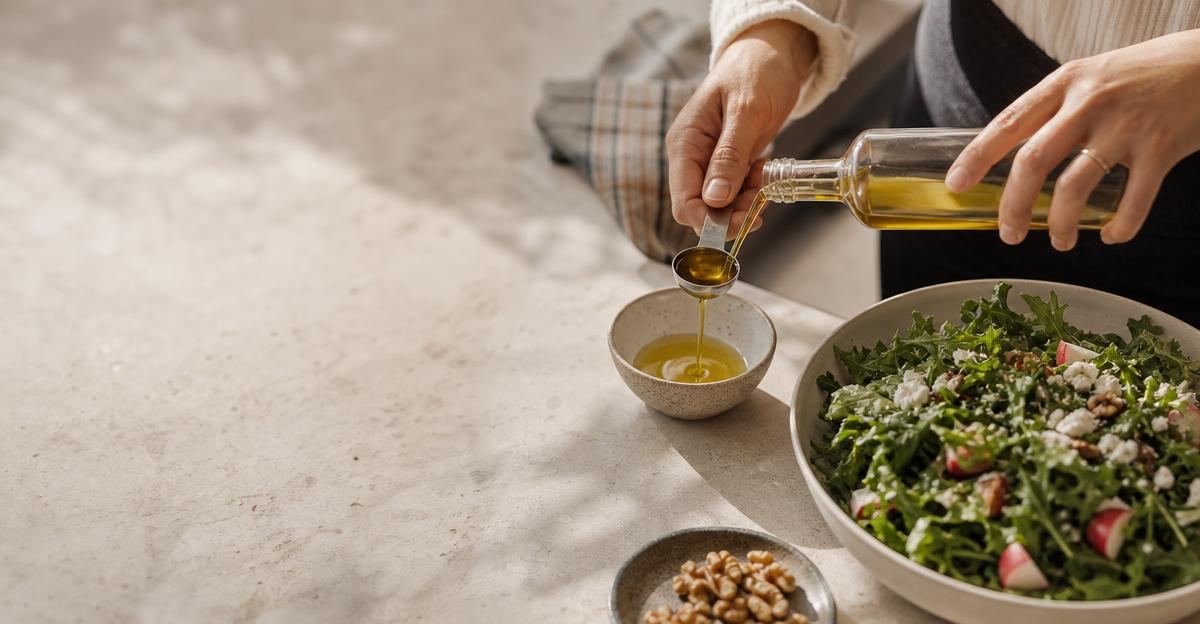
Sauces, dressings, and marinades bring life to everyday cooking, but they are also among the most common sources of tracking errors. A rich vinaigrette can quietly add hundreds of calories to a bowl of fresh greens, while a steak marinade might leave most of its oil behind in the dish.
When you want your nutritional logs to reflect reality without turning dinner preparation into a science experiment, you need a balanced approach. Knowing how to measure these liquids—and what actually ends up on your plate—makes daily nutrition tracking straightforward and stress-free.
The Marinade Math: Total Made vs. Total Consumed
The biggest challenge with marinades is that most of the liquid never enters your body. When you soak chicken breasts in an oil-and-herb mixture and transfer them to a hot grill, a significant portion stays in the bowl or drips into the flames. Logging the entire batch of marinade skews your numbers upward, while ignoring the marinade entirely ignores the oils and sugars absorbed by the meat.
To estimate marinades without overcomplicating your routine, use one of two practical methods:
- The Difference Method: Weigh the full marinade container before placing your meat inside. After removing the meat for cooking, weigh the remaining liquid left behind. Subtract the final weight from the starting weight to find the exact amount absorbed and retained on the surface.
- The Absorption Percentage Rule: If weighing before and after feels too tedious, a reliable culinary rule of thumb is that meat generally retains between 10% and 20% of a standard marinade's weight. If your marinade contains four tablespoons of olive oil, logging roughly one half-to-one tablespoon across the entire batch is usually very close to reality.
If you are cooking batch dishes where meats and sides mingle, understanding how to track multi-ingredient home-cooked meals fast can help you log entire recipes in seconds rather than calculating each component individually.
Why Dressings Hide More Calories Than You Think
Salad dressings behave quite differently from marinades: virtually everything you pour onto your bowl gets eaten. Because salad dressings are typically emulsion-based—relying on oils, tahini, nut butters, or mayonnaise—their caloric density is high.
According to nutritional data from the USDA FoodData Central, a single tablespoon of pure olive oil provides roughly 14 grams of fat and 120 calories. A freehand pour from an oil bottle can easily reach three or four tablespoons without looking excessive, adding nearly 500 uncounted calories to a light lunch.
To track dressings with precision:
- Tare the bottle directly on your scale: Place the salad dressing bottle on your food scale, press the tare (zero) button, and pour your dressing over the salad. Put the bottle back down. The negative number shown on the scale is the exact weight of what you poured.
- Toss before adding more: Greens have broad surface areas. Tossing your salad thoroughly distributes a modest amount of dressing across every leaf, delivering full flavor with half the volume.
- Keep creamy additions separate: When using restaurant dressings, dipping your fork into a side cup before each bite gives you the taste of the dressing with a fraction of the total volume consumed.
Handling Viscous Glazes and Pan Sauces
Pan sauces and glazes fall somewhere between marinades and dressings. When you simmer balsamic vinegar, honey, or soy sauce into a reduction, water evaporates, concentrating the sugars and fats.
If you make a pan sauce by adding butter or cream to meat drippings, you consume whatever you scrape onto your plate. Treat pan reductions like dressings: measure what you put into the pan, and log the portion that actually makes it onto your plate. If half the sauce stays in the skillet, log half the recipe ingredients.
For general wellness and managing medical dietary restrictions, remember that nutritional tracking is a tool for personal awareness. If you have specific medical conditions or metabolic concerns, speak to a clinician or registered dietitian for individualized clinical advice. (If you are coordinating health needs for a family member or managing post-treatment healing, resources like Wound Care At Home When Dressing Changes Need Medical Oversight During Recovery offer helpful context on clinical care at home.)
Making Logging Sustainable Every Day
Precision matters, but consistency matters more. You do not need to stress over every drop of vinegar or pinch of dry spices. Focus your accuracy on high-energy ingredients: cooking oils, butter, sugars, nut pastes, and heavy dairy.
Using simple estimation habits keeps your logging sustainable:
- Note your go-to homemade dressing recipes once so you can quickly log them as a single item later.
- When dining out, assume restaurant sauces contain roughly one tablespoon of added fat per serving unless stated otherwise.
- Rely on visual cues when scales are not available: a standard shot glass is roughly two tablespoons, which is the standard serving size for bottled dressings.
With these simple rules, you can enjoy flavorful food, tender meats, and crisp salads while keeping your nutritional data dependable.
Take the guesswork out of your daily routine. Try Stride to log meals, workouts, and weight in one place.
Put this into practice with Stride
Log meals, training, weight and sleep in seconds, then get guidance that fits your own numbers.
Try Stride free